Trap bar deadlift
Also called trap bar deadlifts, hex bar deadlift, hex-bar deadlift, trap bar deads.
What is a trap bar deadlift?
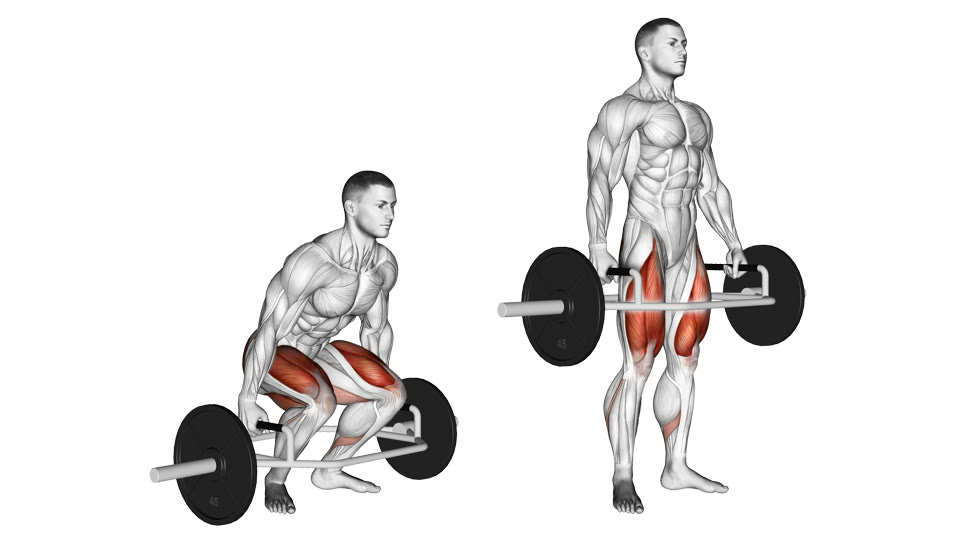
A trap bar deadlift is a floor lift performed while standing inside a hexagonal bar and holding neutral handles at your sides. You extend the hips and knees together to stand, then return the bar to the floor. It mainly trains the gluteus maximus and quadriceps, while the back, trapezius and grip support the lift.
How do you perform a trap bar deadlift?
Set up
- Stand in the middle of the trap-bar frame with a stable roughly hip-width stance and the handles beside your mid-foot.
- Bend your hips and knees, take both neutral handles with straight arms, brace your trunk, and remove the slack without lifting the plates.
Execution
- Push through the whole foot and extend your hips and knees together, keeping both ends of the bar level.
- Finish standing tall without leaning back or bending the elbows.
- Send the hips back, then bend the knees to return the plates to the floor and reset.
Common mistakes
Standing off-centre in the frame
Reset so the handles sit beside the mid-foot; starting too far forward or back makes the frame tilt and changes the pull.
Yanking from a loose setup
Brace and take the slack out before the plates leave the floor so the torso and bar begin together.
Letting one end tilt
Keep pressure even in both hands and reset the bar on the floor instead of carrying an uneven rep forward.
Where it fits in a session
As the main lower-body lift or early in a full-body session.
Use the handle height you can set up from consistently. Return each repetition to the floor unless you deliberately choose the Romanian-deadlift variation.
Muscles worked
Primary
Secondary
Schematic surface view. Some muscles are partly visible or not shown.
The gluteus maximus and quadriceps extend the hips and knees. The spinal erectors steady the trunk while the trapezius and grip support the bar.
Variations
- Low-handle trap bar deadlift — Uses the lower handles, increasing the starting range compared with the high handles shown here.
- Conventional deadliftUses a straight bar in front of the legs rather than a frame around the lifter.
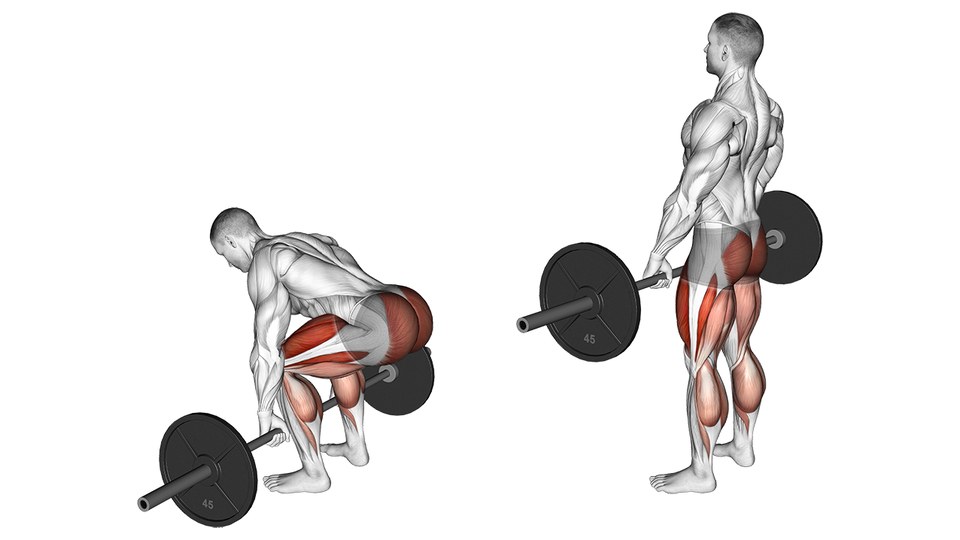
- Trap bar Romanian deadlift — Begins from standing and uses a hip-hinge repetition rather than resetting from the floor.
Related tools
Frequently asked questions
Should I use the high or low handles?
High handles shorten the starting range; low handles lengthen it. The illustration uses high handles. Choose one height and log it consistently rather than treating the two setups as identical.
Is a trap bar deadlift a squat or a deadlift?
It is a deadlift because each repetition starts from the floor, but the surrounding bar allows more knee bend than many straight-bar setups. Do not force it to match one prescribed torso angle.
Should every rep return to the floor?
Yes for the version on this page. Let the plates settle, rebuild your position, and begin the next repetition from a stable floor start.