
Underhand barbell row
Also called reverse-grip barbell row, supinated barbell row.
What is an underhand barbell row?
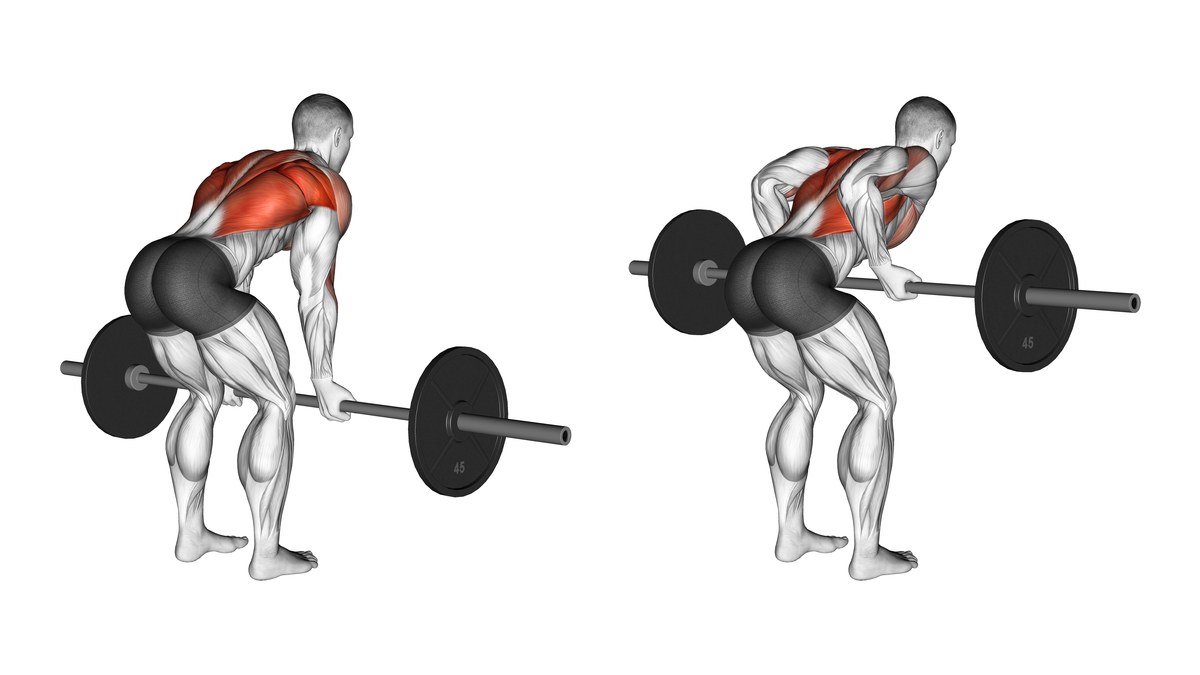
An underhand barbell row is a bent-over row performed with an underhand grip on a straight bar. You hold a forward hip hinge while pulling the bar toward your abdomen, then straighten your arms without resting the bar on the floor. It trains the back and biceps.
How do you perform an underhand barbell row?
Set up
- Put the loaded bar on a clear, level floor. Place your feet roughly hip-width apart with the bar above your mid-foot. Bend your knees and hips to take an underhand grip just outside your legs, with your thumbs around the bar.
- Brace your trunk, keep your back steady and stand with the bar close to your legs. Your palms face forward and the bar rests against your thighs.
- Soften your knees and send your hips back until your torso leans well forward. Hold your back steady, keep your neck in line with it and let the bar hang below your shoulders with straight arms and wrists.
Execution
- Bend your elbows and guide them back beside your ribs as the bar approaches your abdomen. Let your shoulder blades draw together without lifting your chest to meet the bar.
- Reverse the movement before you need to change your torso angle or curl your wrists to pull farther. The bar can touch your abdomen, but do not force contact.
- Let the bar descend smoothly until your elbows straighten. Keep the same hinge and repeat with the bar suspended between repetitions.
- To finish, straighten your hips with the bar close to your legs. Then bend your hips and knees to set the bar down under control.
Common mistakes
Driving the hips forward to finish each pull
Use less weight if each repetition needs a standing motion. Establish the hinge before starting and keep it until the set is finished.
Bending the wrists to gain the last bit of height
Keep your knuckles in line with your forearms. End the pull where you can maintain that position instead of turning the row into a wrist curl.
Reaching for a compulsory contact point
Your grip and proportions affect where the bar meets your body. Keep the shoulders and torso controlled rather than changing position just to touch the bar to your stomach.
Where it fits in a session
Use it as an unsupported barbell pulling exercise in your back or pull session.
Choose a load that lets you repeat the same hinge, grip and arm range. Finish the set when holding that position becomes the limiting factor, and compare your repetitions using the same setup each time.
Muscles worked
Primary
Secondary
Schematic surface view. Some muscles are partly visible or not shown.
The lats and rear deltoids help draw the upper arms back. The middle trapezius and rhomboids bring the shoulder blades toward the spine, while the biceps bend the elbows.
Variations
- Overhand barbell rowUses an overhand grip on the bar while keeping the unsupported hip-hinge setup.
- Pendlay rowUses an overhand grip and returns the bar to the floor before each repetition.
Frequently asked questions
Is an underhand row the same as a reverse-grip row?
Yes. Reverse-grip barbell row and supinated barbell row describe the same grip taught here: palms forward while standing, with that hand position maintained as you hinge and row.
Is this a Yates row?
The names sometimes overlap. This guide teaches a held forward hinge. A more upright Yates-style row is a different setup, so keep the torso position consistent when comparing your training.
What muscles does an underhand barbell row work?
The lats and rear deltoids help move the upper arms back, the middle trapezius and rhomboids draw the shoulder blades inward, and the biceps bend the elbows. The underhand grip does not make this a biceps-only exercise.
Where should the bar touch?
Aim toward the abdomen and let your proportions determine the exact point. Stop the pull before your torso rises or your wrists fold; touching the bar is optional.
What if I cannot hold the underhand grip comfortably?
Do not force your wrists into the position. Practise with a lighter bar, or choose an overhand barbell row or a dumbbell row with a hand position you can control.
Sources
- Molly Smith, DipCNM, mBANT; reviewed by Jana Vasković, MD. Latissimus dorsi muscle. Kenhub. https://www.kenhub.com/en/library/anatomy/latissimus-dorsi-muscle
- Gordana Sendić, MD; reviewed by Dimitrios Mytilinaios, MD, PhD. Trapezius muscle. Kenhub. https://www.kenhub.com/en/library/anatomy/trapezius-muscle
- Adrian Rad, BSc (Hons); reviewed by Roberto Grujičić, MD. Rhomboid muscles. Kenhub. https://www.kenhub.com/en/library/anatomy/rhomboid-muscles
- Egle Pirie, BSc (Hons); reviewed by Roberto Grujičić, MD. Deltoid muscle. Kenhub. https://www.kenhub.com/en/library/anatomy/the-deltoid-muscle
- Achudhan Karunaharamoorthy, MD; reviewed by Dimitrios Mytilinaios, MD, PhD. Biceps brachii muscle. Kenhub. https://www.kenhub.com/en/library/anatomy/biceps-brachii-muscle