
V-up
Also called V-ups, jackknife sit-up, jackknife sit-ups, jack knife sit-up.
What is a V-up?
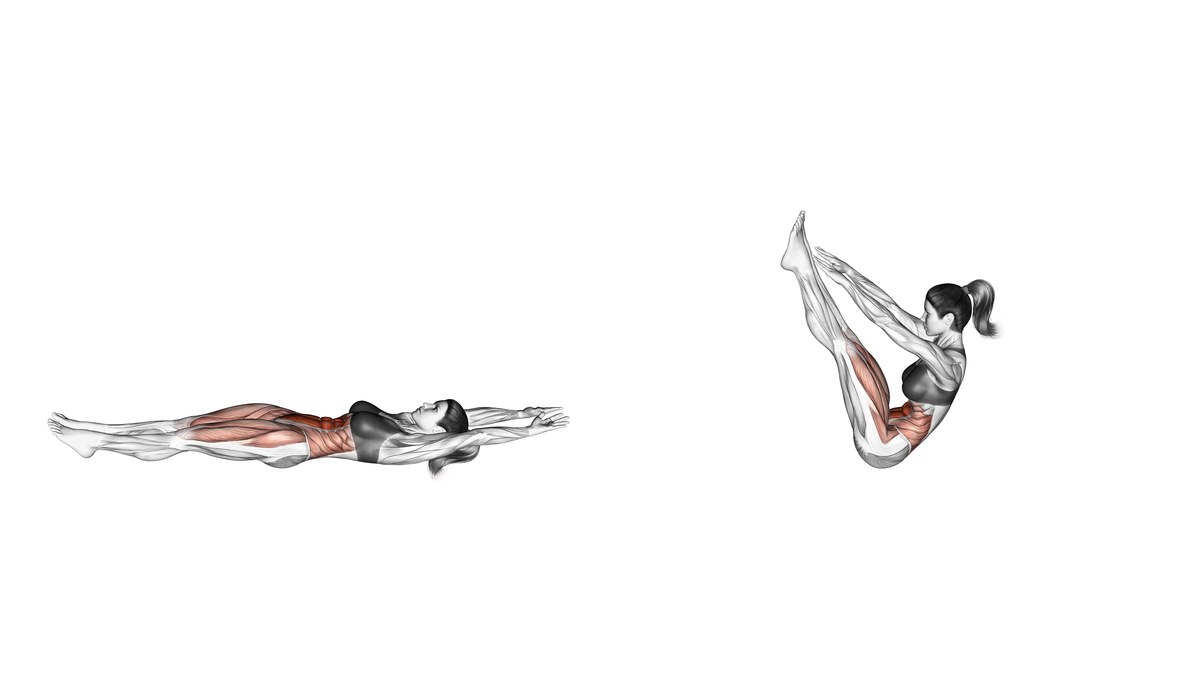
A V-up is an abdominal exercise in which you lift your trunk and straight legs toward each other from the floor, then lower them together. Your hands reach toward your feet as you balance briefly on your pelvis. The abdominal muscles and hip flexors work during the movement.
How do you perform a V-up?
Set up
- Lie on your back with your legs together and arms extended overhead. Use a mat and leave room for your hands and feet.
- Gently brace your abdomen and prepare to lift your upper body and legs together.
Execution
- Raise your legs and curl your upper body off the floor at the same time, reaching your hands toward your feet. Keep a soft bend in your knees if needed.
- Meet in a balanced V position without throwing your arms or snapping your neck forward. Your hands do not have to touch your toes.
- Lower your torso and legs together under control until you return to the starting position, then repeat.
Common mistakes
Swinging the arms to launch the rep
Use a bent-knee version if you cannot lift without a large arm swing.
Dropping onto the floor after the reach
Shorten the movement so you can control the return as well as the lift.
Where it fits in a session
Place it with other abdominal work once you can control both the lift and return.
Use bent knees or a smaller range before adding repetitions to an uncontrolled set. Count one complete lift and return as one repetition.
Muscles worked
Primary
Secondary
Schematic surface view. Some muscles are partly visible or not shown.
The abdominal muscles curl the trunk as the hip flexors bring the legs toward it.
Variations
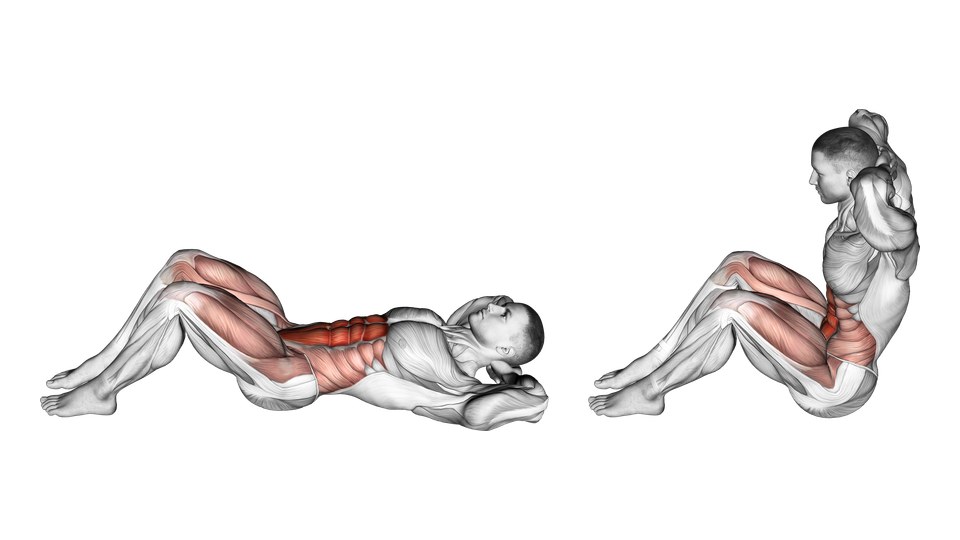
- Bent-knee V-up — Bring bent knees toward your chest instead of keeping the legs long.
Frequently asked questions
Are V-ups and jackknife sit-ups the same?
Jackknife sit-up is another name used for the floor V-up described here. A stability-ball jackknife, where the feet roll a ball toward the hands from a plank, is a different exercise.
Do I have to touch my toes?
No. Reach toward the feet and stop where you can balance without using a swing. Toe contact is not the goal of the repetition.
What should I do if straight legs are too difficult?
Start with bent knees and reach toward your shins. Return slowly to the floor, then gradually try a longer leg position.
Sources
- J. Gordon Betts and colleagues, OpenStax. Anatomy and Physiology 2e, section 11.4: Axial muscles of the abdominal wall and thorax. 2022. https://openstax.org/books/anatomy-and-physiology-2e/pages/11-4-axial-muscles-of-the-abdominal-wall-and-thorax
- OpenStax. Anatomy and Physiology 2e, section 11.6: Appendicular muscles of the pelvic girdle and lower limbs. 2022. https://openstax.org/books/anatomy-and-physiology-2e/pages/11-6-appendicular-muscles-of-the-pelvic-girdle-and-lower-limbs