
Walking lunges
Also called walking lunge, bodyweight walking lunge, alternating walking lunges.
What is a walking lunges?
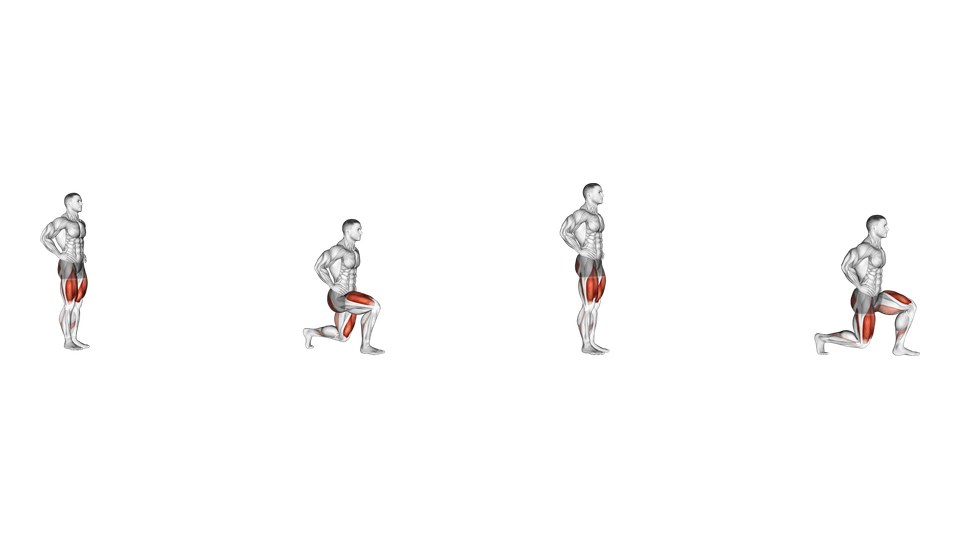
Walking lunges are alternating forward lunges in which each repetition carries you into the next step. They train the quadriceps and glutes one leg at a time and require enough open floor space to keep moving.
How do you perform a walking lunges?
Set up
- Choose a clear, level path and stand tall with your feet about hip width apart.
- Brace lightly and place your hands on your hips or let your arms move naturally for balance.
Execution
- Step forward into a stable split stance and lower the back knee toward the floor.
- Keep the front foot flat and the front knee moving in the same direction as the toes.
- Push through the front foot, bring the rear leg through and step directly into the next lunge.
Common mistakes
Placing each foot on one narrow line
A little side-to-side space gives the hips and knees a steadier base as you travel forward.
Pushing mostly from the trailing toes
Driving through the front foot keeps the working leg responsible for moving you into the next step.
Rushing the transition
Standing fully enough to control the next foot placement prevents each lunge from turning into a fall forward.
Where it fits in a session
Usually placed after heavier two-legged work or used as a bodyweight leg exercise when space allows.
Count steps per leg and stop the set before balance changes the stride or knee path.
Muscles worked
Primary
Secondary
Schematic surface view. Some muscles are partly visible or not shown.
The front-leg quadriceps and gluteus maximus drive each step, while other hip muscles assist and keep the pelvis steady.
Variations
- Forward lungeSteps forward and returns to the original stance instead of continuing across the floor.
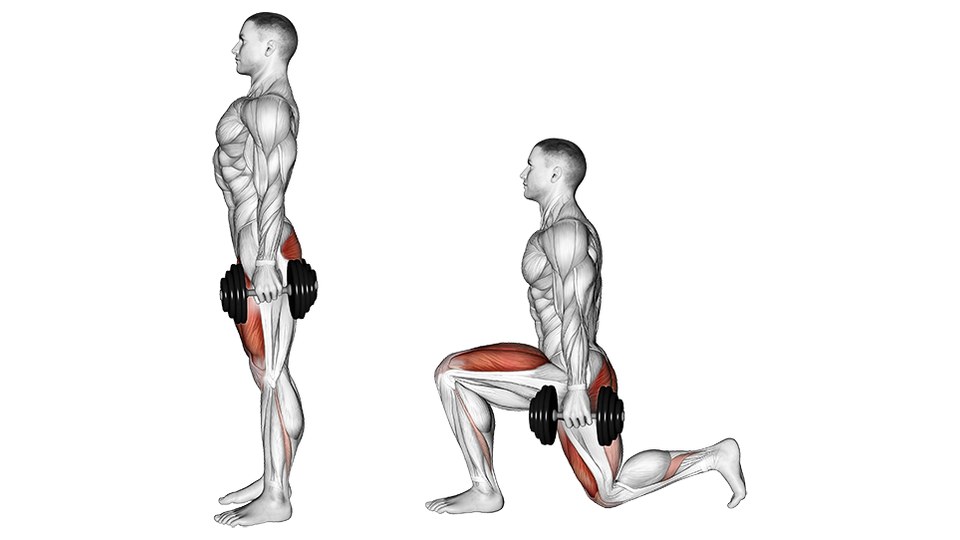
- Dumbbell walking lunge — Adds a dumbbell in each hand once the bodyweight path is stable.
- Reverse lunge — Steps backward while the front foot stays planted.
Frequently asked questions
What muscles do walking lunges work?
They mainly train the quadriceps and gluteus maximus of the front leg. The hamstrings, adductor magnus and gluteus medius assist and stabilize the hip.
How long should each walking-lunge step be?
Step far enough to lower with the front foot flat and both legs stable. A cramped step usually makes the body tip forward.
Should your back knee touch the floor?
Lower it close to the floor without dropping or bouncing. A light touch is fine if it stays controlled and the surface is comfortable.
How are walking lunges different from forward lunges?
A forward lunge returns to the starting stance after each rep. A walking lunge brings the rear leg through and continues into the next step.
Sources
- Bordoni B, Varacallo MA. Anatomy, Bony Pelvis and Lower Limb: Thigh Quadriceps Muscle. StatPearls. https://www.ncbi.nlm.nih.gov/books/NBK513334/
- Elzanie A, Borger J. Anatomy, Bony Pelvis and Lower Limb, Gluteus Maximus Muscle. StatPearls. https://www.ncbi.nlm.nih.gov/books/NBK538193/