
Bent-knee fallout
Also called bent knee fall out, BKFO.
What is a bent-knee fallout?
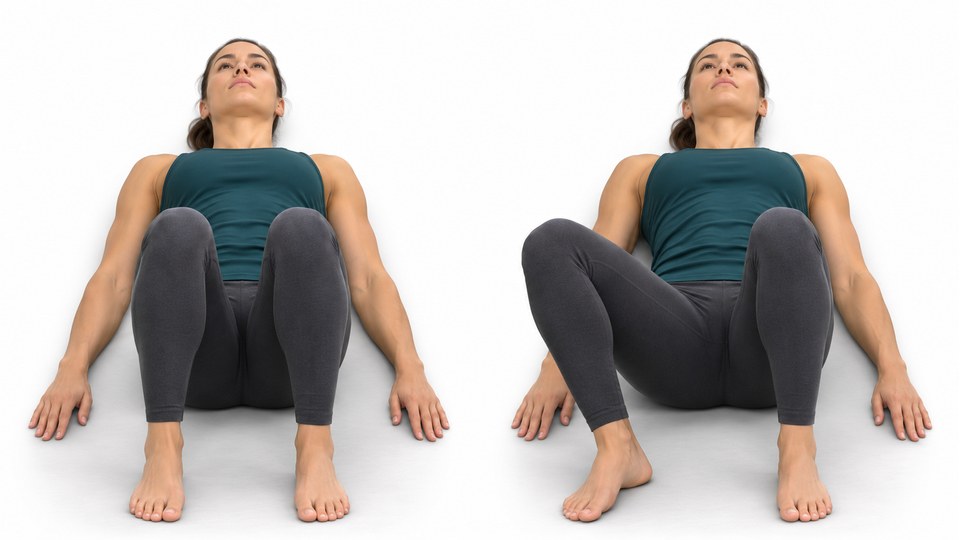
A bent-knee fallout is a supine control drill: one bent knee opens to the side and returns while the pelvis stays still. Both feet keep contact with the floor. The abdominal wall works to steady the trunk as the leg changes position.
How do you perform a bent-knee fallout?
Set up
- Lie facing upward with bent knees, both feet supported and arms resting beside your trunk.
- Choose a comfortable foot spacing and gently firm your abdomen without holding your breath.
Execution
- Allow one knee to open a little toward its own side while the other knee stays in place.
- Stop the opening before your pelvis rolls; keep contact through both feet.
- Bring the knee upright again, then repeat on the other side.
Common mistakes
Rolling the pelvis with the knee
Use less opening so the movement stays at the hip rather than taking your whole trunk to one side.
Opening both knees together
Work with one moving knee for this version. Reset the other knee and foot before changing sides.
Forcing the knee toward the floor
The floor is not the target. Work within the range you can control comfortably.
Where it fits in a session
Use as a chosen abdominal-control drill in a session you can manage comfortably.
Choose a short set that leaves breathing and movement controlled. Keep the starting position and range consistent before adding repetitions. Record any variation in the set notes.
Muscles worked
Primary
Secondary
- None listed in this guide
Schematic surface view. Some muscles are partly visible or not shown.
Abdominal targets describe the trunk-control task, not isolation or a ranking of muscle activation. The leg movement and the steadying work are different roles.
Variations
- Smaller knee opening — Keep the same setup and reduce the sideways movement.
Articles
Frequently asked questions
Which muscles do bent-knee fallouts target?
This abdominal-control version uses the lateral abdominal wall, including the transversus abdominis and obliques, to help keep the pelvis steady. Those targets describe the trunk task rather than a measured ranking of muscle activity.
Should my feet touch each other?
Choose a comfortable foot spacing and keep both feet in contact with the floor as one knee opens. Keep the same spacing between repetitions so that the movement is repeatable.
How far should the knee open?
Use the range that allows your pelvis to stay still without pain. Start with a small opening and return before you have to roll or brace harder to get farther.
Is this a clamshell or a butterfly stretch?
Neither describes this setup. A clamshell is performed on your side; a butterfly stretch opens both knees. Here you lie on your back and move one knee while controlling the pelvis.
Can I use this after pregnancy?
Choose a version that fits your recovery and any advice from your maternity or pelvic-health team. Stop if the movement brings on pain, urine or bowel leakage, or pelvic heaviness, and get advice for symptoms that persist or recur. Being able to perform this drill is not a test of readiness for harder training.
Sources
- Gordana Sendić, MD; reviewer Roberto Grujičić, MD. Transversus abdominis muscle. Kenhub. https://www.kenhub.com/en/library/anatomy/transversus-abdominis-muscle
- Gordana Sendić, MD; reviewer Declan Tempany, BSc (Hons). Internal abdominal oblique muscle. Kenhub. https://www.kenhub.com/en/library/anatomy/internal-abdominal-oblique-muscle
- Jana Vasković, MD; reviewer Declan Tempany, BSc (Hons). External abdominal oblique muscle. Kenhub. https://www.kenhub.com/en/library/anatomy/external-abdominal-oblique-muscle