
Cable curl
Also called cable biceps curl, straight-bar cable curl, low cable curl.
What is a cable curl?
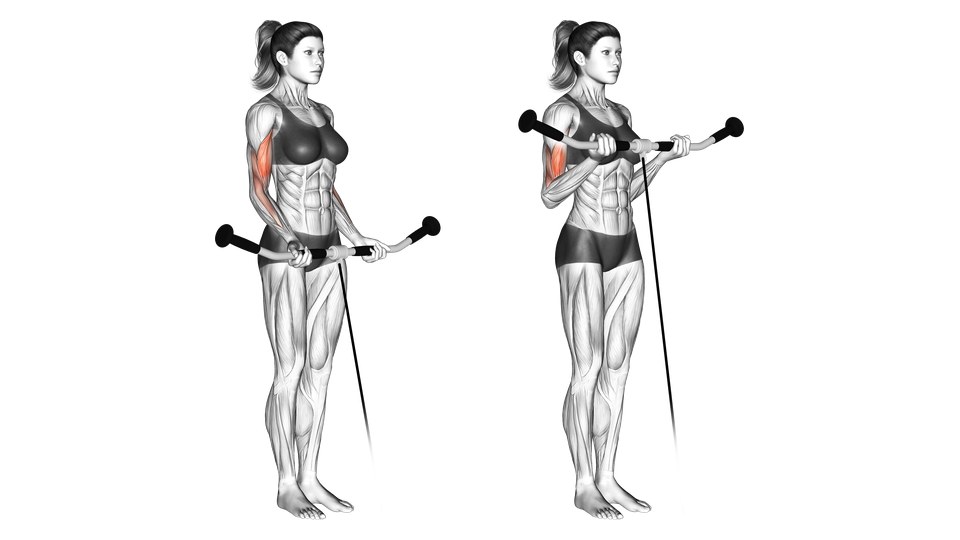
The cable curl is a standing elbow-flexion exercise performed from a low pulley. The palm-up bar version mainly trains the biceps brachii, while the brachialis, brachioradialis and forearm flexors assist.
How do you perform a cable curl?
Set up
- Attach a curl bar to the low pulley, take an underhand grip around shoulder width and stand close enough for the cable to stay clear of your legs.
- Stand tall with your arms down, elbows near your sides and wrists following the bar's angle.
Execution
- Curl the bar upward by bending the elbows while keeping the torso still.
- Finish before the elbows drift far forward or the forearms tip beyond vertical.
- Lower under control until the arms are straight, without letting the stack slam down.
Common mistakes
Rocking backward to start the bar
Torso movement helps the cable move without asking the elbow flexors to produce the same work.
Letting the elbows travel far forward
The top position then becomes a shoulder movement and the cable can unload the curl.
Dropping the stack between reps
A noisy, uncontrolled return changes the bottom position and removes tension before the next rep.
Where it fits in a session
Usually after compound pulling or beside other arm isolation exercises.
Use a load that allows straight arms at the bottom without rocking the torso or dropping the stack.
Muscles worked
Primary
Secondary
Schematic surface view. Some muscles are partly visible or not shown.
The palm-up bar version trains the biceps brachii with help from the other elbow and grip flexors.
Variations
- Rope cable curl — Uses a rope and a more neutral hand position than the palm-up bar version.
Related tools
Frequently asked questions
What muscles do cable curls work?
They mainly train the biceps brachii. The brachialis, brachioradialis and forearm flexors also help bend the elbows and hold the bar.
Should your elbows move during cable curls?
Keep them near your sides. A small amount of forward travel at the very top is not a failed rep, but large movement changes the exercise and can unload the cable.
Are cable curls the same as barbell curls?
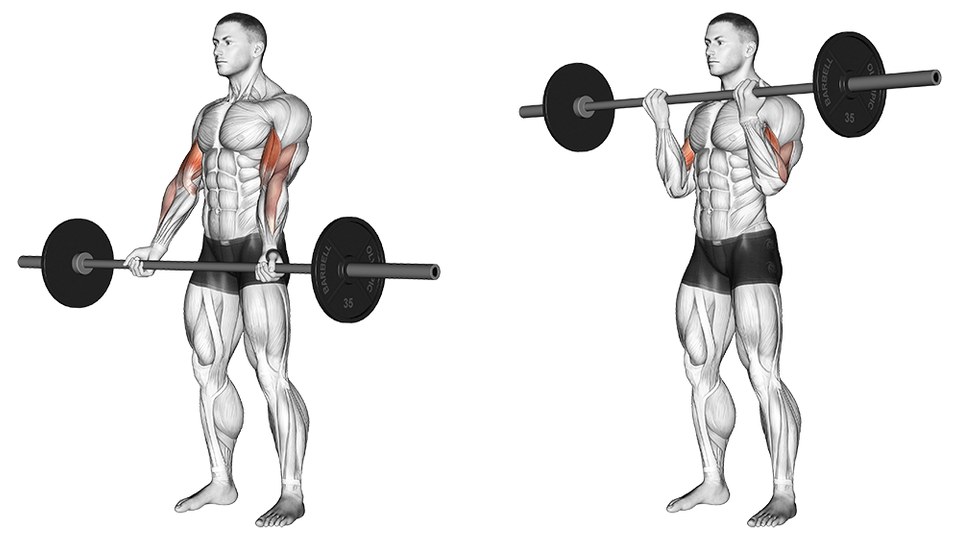
They use the same elbow-flexion pattern, but the cable pulls along its line toward the low pulley while a barbell is pulled straight down by gravity.
Which attachment should you use for cable curls?
A straight or curved bar suits the standard palm-up version. An EZ-style bar may feel easier on the wrists, while a rope creates a more neutral grip and should be logged as that variation.
Sources
- Anatomy, Shoulder and Upper Limb, Biceps Muscle. StatPearls, NCBI Bookshelf. https://www.ncbi.nlm.nih.gov/books/NBK519538/
- Plantz MA, Bordoni B. Anatomy, Shoulder and Upper Limb, Brachialis Muscle. StatPearls, NCBI Bookshelf. https://www.ncbi.nlm.nih.gov/books/NBK551630/
- Anatomy, Shoulder and Upper Limb, Forearm Brachioradialis Muscle. StatPearls, NCBI Bookshelf. https://www.ncbi.nlm.nih.gov/books/NBK526110/