
Decline dumbbell press
Also called decline dumbbell bench press, dumbbell decline press.
What is a decline dumbbell press?
A decline dumbbell press is a chest press with a dumbbell in each hand while you lie on a bench with your head below your hips and your feet secured. You bend your elbows to lower the weights beside your chest, then press them back up. It trains the chest, with help from the triceps and front shoulders.
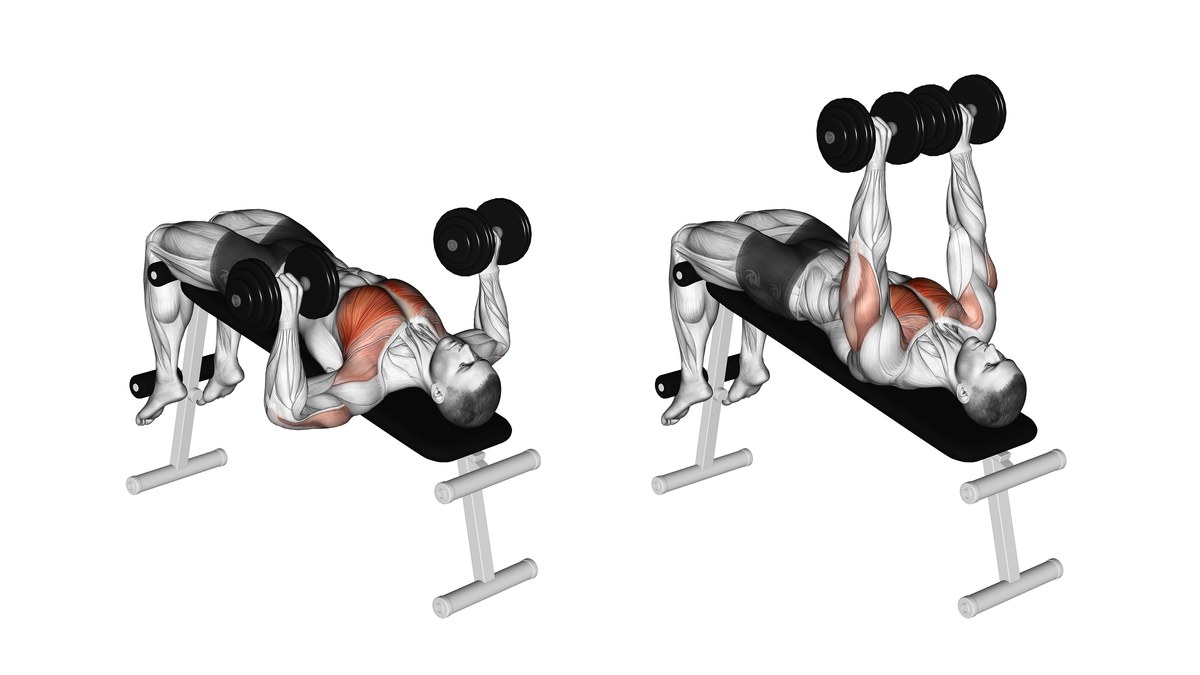
How do you perform a decline dumbbell press?
Set up
- Set a decline bench firmly in place and adjust its foot pads to hold your legs securely. Start with light dumbbells and arrange for a helper to pass them to you and take them back.
- Secure your feet, lie back empty-handed, and settle your head, upper back and hips on the pad. Draw your shoulder blades together and keep them against the bench.
- Have your helper pass you the dumbbells one at a time. Hold them above your chest with straight arms, palms toward your feet and wrists straight.
Execution
- Bend both elbows to lower the dumbbells beside your lower chest. Keep your wrists above your elbows and your upper arms angled away from your torso, below shoulder level.
- Stop at a comfortable depth while your shoulders stay settled on the bench.
- Press both dumbbells up over your chest until your elbows straighten. Keep the weights separate and repeat under control.
- End the set before you struggle to control the weights. Have your helper take both dumbbells before you sit up and release your feet.
Common mistakes
Struggling with the weights while getting on or off the bench
Plan the handoff before the set. Keep your feet secured and stay lying down until your helper has taken both dumbbells, then sit up without the weights.
Turning the press into a fly
Keep your elbows bent as you lower. If the weights spread far beyond your elbows, bring them back over your forearms and use less weight.
Chasing a deeper bottom position
Stop before the shoulders roll forward or the weights pull you out of position. Use a depth you can repeat with control rather than forcing the dumbbells down to the bench.
Where it fits in a session
Use this as one of the presses in your chest session.
Start lighter than you expect and stop with enough control left for the planned handoff. Record the weight of one dumbbell and use the same bench setting when comparing sessions.
Muscles worked
Primary
Secondary
Schematic surface view. Some muscles are partly visible or not shown.
The chest moves the upper arms across the body, while the triceps straighten the elbows. The front shoulders also help with the press.
Variations
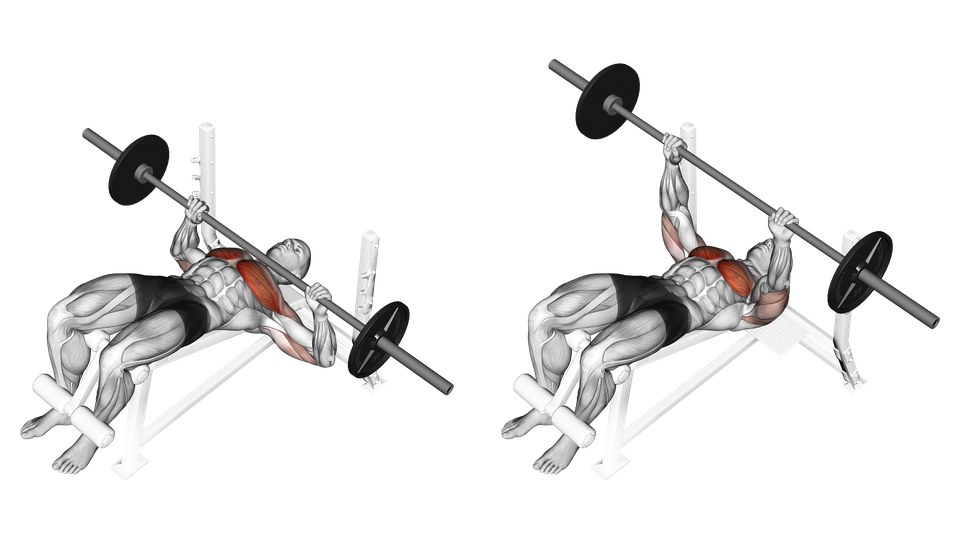
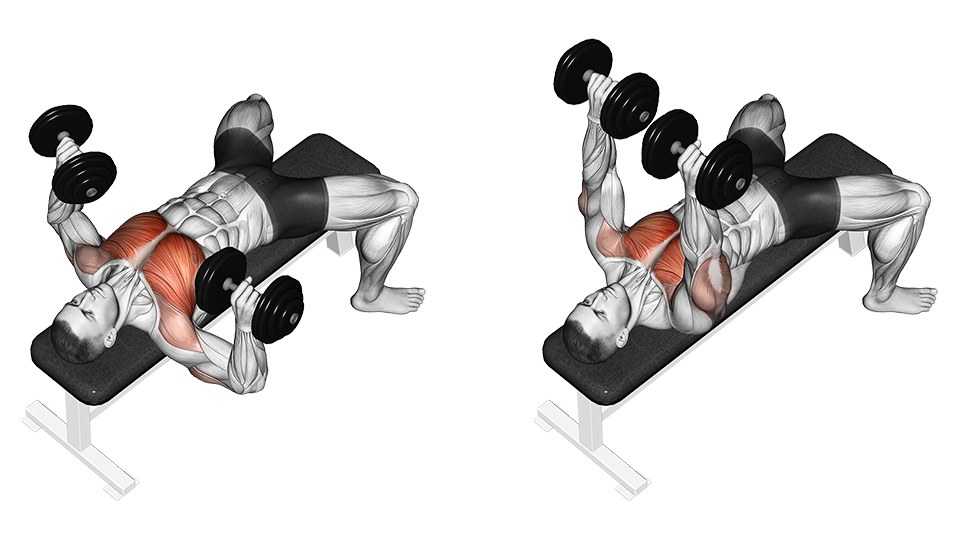
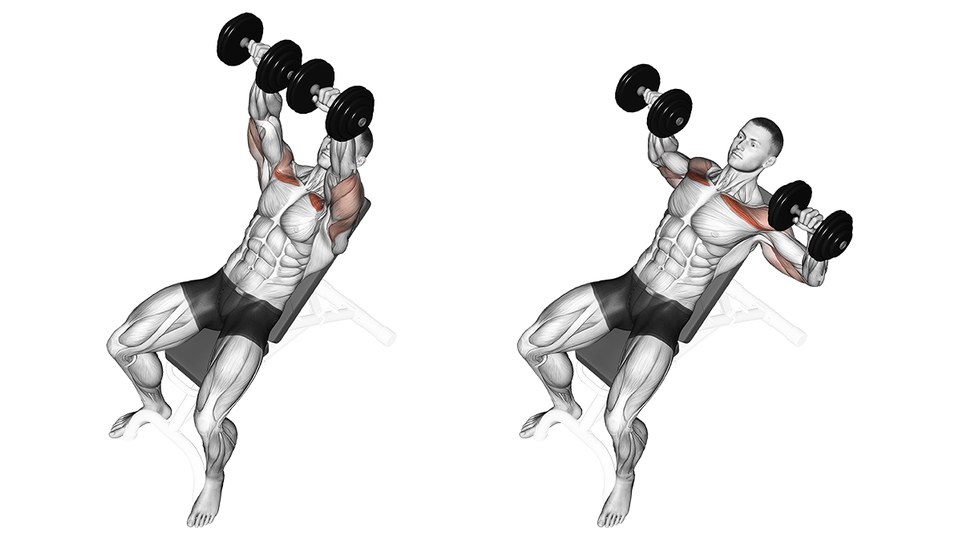
Related tools
Frequently asked questions
What muscles does the decline dumbbell press work?
It works the pectoralis major, the main chest muscle, with the triceps at the back of the upper arm and the front deltoids helping the press. The triceps straighten your elbows as you push the weights up.
How do I get on and off the decline bench with dumbbells?
Lie back with your feet secured before your helper passes you the weights. At the end, have them take both dumbbells before you sit up. Practice the handoff with light weights first. If you cannot arrange help, choose a press with a setup you can manage on your own.
Do the dumbbells need to touch at the top?
No. Finish with your hands above your chest. There is no need to knock the weights together or reach your shoulders off the pad.
Can I do it on a flat bench?
That is a flat dumbbell bench press. Use the flat version if your bench cannot hold your legs securely in the decline position, and log it separately.
How much decline should I use?
Begin with a mild decline on a bench designed for it. Keep the same setting between sessions and choose a position in which you can stay secure throughout the set.
Sources
- Baig MA, Bordoni B. Anatomy, Shoulder and Upper Limb, Pectoral Muscles. StatPearls. Updated 2023. https://www.ncbi.nlm.nih.gov/sites/books/NBK545241/
- Tiwana MS, Sinkler MA, Bordoni B. Anatomy, Shoulder and Upper Limb, Triceps Muscle. StatPearls. Updated 2023. https://www.ncbi.nlm.nih.gov/sites/books/NBK536996/
- Elzanie A, Varacallo MA. Anatomy, Shoulder and Upper Limb, Deltoid Muscle. StatPearls. Updated 2024. https://www.ncbi.nlm.nih.gov/sites/books/NBK537056/
- Christian JR, Gothart SE, Graham HK, Barganier KD, Whitehead PN. Analysis of the Activation of Upper-Extremity Muscles During Various Chest Press Modalities. J Strength Cond Res. 2023;37(2):265–269. https://pubmed.ncbi.nlm.nih.gov/36026487/