Push-up
Also called pushup, push up, push-ups, press-up.
What is a push-up?
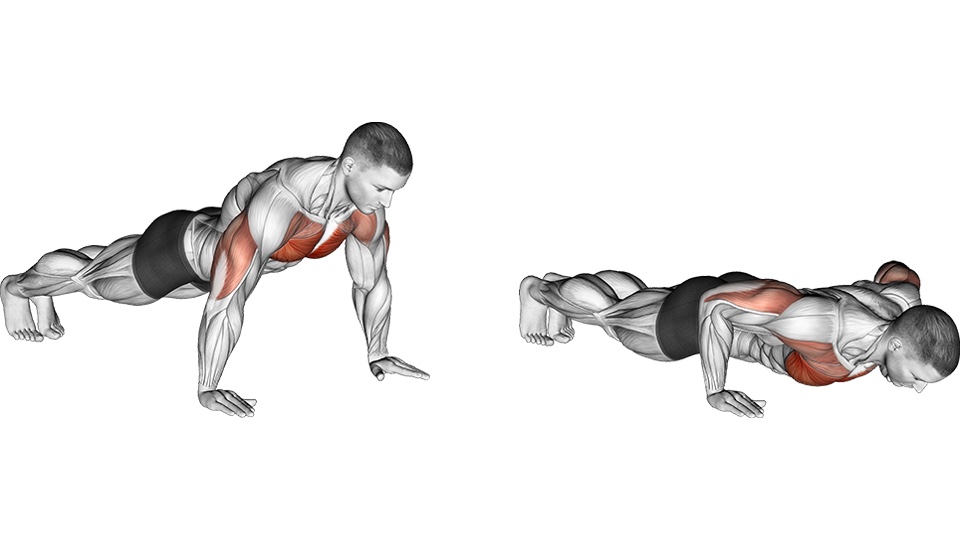
A push-up is a bodyweight press performed face down with the hands and toes on the floor. You lower the chest by bending the elbows, then press back to straight arms while keeping the body in one line. It trains the pectoralis major, with the anterior deltoids and triceps assisting.
How do you perform a push-up?
Set up
- Place your hands slightly wider than shoulder width with your fingers pointing forward, then step your feet back until your arms and legs are straight.
- Brace your stomach and squeeze your glutes so your head, hips and heels form one line.
Execution
- Bend your elbows and lower your chest toward the floor, letting the elbows angle back rather than straight out to the sides.
- Go as low as you can while keeping the same straight body position, aiming to bring your chest close to the floor.
- Press the floor away until your arms are straight, then begin the next rep without letting your hips sag.
Common mistakes
Letting the hips sag
A dropped middle shortens the distance the chest travels and turns the rep into a changing shape. Brace before you lower and switch to an incline if you cannot keep the body in one line.
Lifting the hips first
Sending the hips up leaves the chest behind and makes each rep smaller. The shoulders and hips should rise together.
Flaring the elbows straight out
A wide T shape puts the upper arms in a more awkward shoulder position. Let the elbows point diagonally back so the body looks more like an arrow at the bottom.
Reaching the head toward the floor
Moving the head can look like extra depth while the chest stays high. Keep the neck in line with the torso and measure depth by the chest.
Where it fits in a session
As the main press in a bodyweight session, or after heavier pressing in an upper-body workout.
Change the angle before sacrificing the shape of the rep. Put the hands on a stable raised surface to make it easier, or raise the feet or add external load once floor push-ups are comfortably repeatable.
Muscles worked
- pectoralis major
- anterior deltoid
- triceps brachii
The pectoralis major moves the upper arm across the body, the anterior deltoid assists at the shoulder, and the triceps straighten the elbows. The abdominal and gluteal muscles brace the trunk, but they are not listed as targets because they hold position rather than drive the press.
What lifters actually do
The exact built-in push-up label is rare in RepCount's historical logs: fewer than one percent of regular users have logged it, and it appears in roughly one workout in thirteen hundred. When it does appear, lifters log about three sets inside a session of six or seven exercises. Bench press occurs in about 20% of those sessions, dips in about 18%, dumbbell lateral raises in about 17%, pull-ups in about 14% and incline dumbbell press in about 13%. These figures do not include custom push-up entries, so they describe use of this built-in label rather than the movement's total use.
Most often trained alongside
Share of push-up sessions that also include each exercise.
- Bench press19.8%
- Dips17.7%
- Dumbbell lateral raise17.3%
- Pull-up14.2%
- Incline dumbbell press12.6%
Figures come from workouts tracked in RepCount.
Variations
- Incline push-up — Hands on a stable raised surface, reducing the share of bodyweight you press.
- Kneeling push-up — Knees stay on the floor to shorten the lever and make the exercise easier.
- Close-grip push-up — Hands closer together and elbows nearer the sides, increasing the demand on the triceps.
- Decline push-up — Feet raised above the hands, shifting more bodyweight toward the upper body.
- Weighted push-up — Adds resistance with a vest, band or securely placed plate.
- Ring push-up — Hands on suspended rings, adding instability and allowing the hands to rotate naturally.
Frequently asked questions
What muscles do push-ups work?
The pectoralis major is the main target. The anterior deltoids assist at the shoulders, and the triceps extend the elbows as you press away from the floor. Your stomach and glutes work isometrically to keep the trunk and hips in one line.
How wide should my hands be for push-ups?
Start slightly wider than shoulder width, with the fingers pointing forward or a little outward. Move a few centimetres either way if that makes the wrists or shoulders more comfortable, but avoid an extremely wide position that forces the elbows straight out.
How low should a push-up go?
Lower until the chest is close to the floor while the body stays in one line. If your hips sag or your head reaches down first, that depth is beyond the range you can control today. Raise the hands and practise the same full movement at an easier angle.
What should I do if I cannot perform a floor push-up?
Put your hands on a stable bench, box or rail. A higher surface makes the exercise easier while preserving the straight-body position and the same pressing movement. Lower the surface gradually as you get stronger.
Are kneeling push-ups or incline push-ups better for beginners?
Both reduce the load. An incline keeps the body in the same head-to-heel line as a floor push-up, so the technique transfers directly as the surface gets lower. A kneeling push-up needs only floor space and is a useful option when no stable raised surface is available.
Are push-ups common in RepCount workouts?
Not under this exact built-in label: fewer than one percent of regular RepCount users have logged it, and it appears in roughly one workout in thirteen hundred. That does not show how common push-ups are overall, because custom push-up entries are excluded and were not sized here.
Sources
- Solari F, Burns B. Anatomy, Thorax, Pectoralis Major Major. StatPearls, NCBI Bookshelf. https://www.ncbi.nlm.nih.gov/books/NBK525991/
- Elzanie A, Varacallo MA. Anatomy, Shoulder and Upper Limb, Deltoid Muscle. StatPearls, NCBI Bookshelf. https://www.ncbi.nlm.nih.gov/books/NBK537056/
- Tiwana MS, Sinkler MA, Bordoni B. Anatomy, Shoulder and Upper Limb, Triceps Muscle. StatPearls, NCBI Bookshelf. https://www.ncbi.nlm.nih.gov/books/NBK536996/