Standing cable row
Also called standing V-bar cable row.
What is Standing cable row?
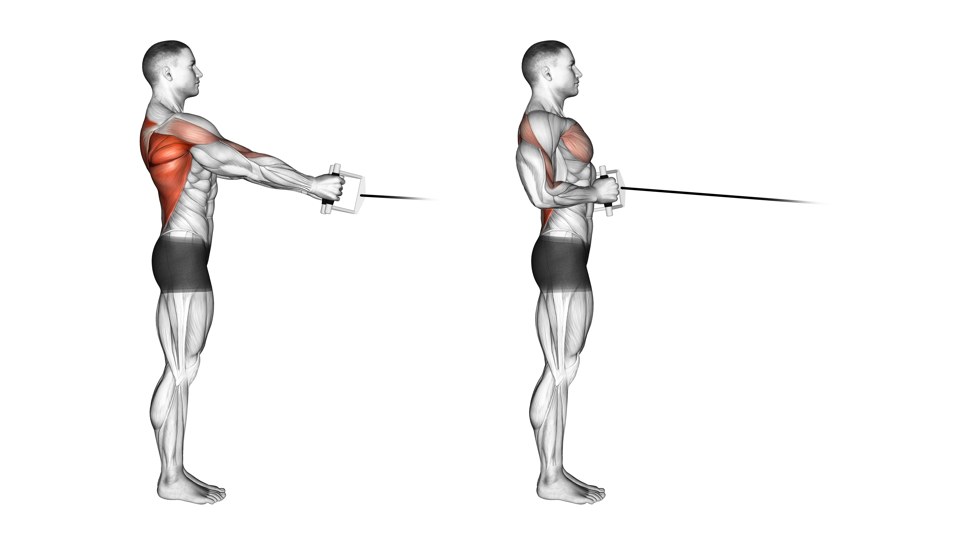
The standing cable row pulls a close-grip handle toward the lower ribs while you stand facing the pulley. It trains the back and elbow flexors without a seated support.
How to do Standing cable row
Set up
- Set a close-grip handle around waist height and stand facing the cable.
- Step back until the cable is taut, soften your knees and reach forward with a steady torso.
Execution
- Bring the handle toward your lower ribs while your elbows travel backward near your sides.
- Finish without leaning back or lifting the shoulders toward the ears.
- Reach forward under control while keeping your feet in the same place.
Common mistakes
Shrugging at the finish
Once the shoulders ride up toward the ears the upper trapezius is elevating the shoulder blade rather than the middle fibres and rhomboids pulling it toward the spine. The finish of the row turns into a shrug.
Holding the shoulders locked back and only bending the arms
If the shoulder blades never travel forward at the start and never draw together at the finish, the scapular half of the movement has been deleted and the row becomes a long-lever curl. The muscles between the shoulder blades work through the range you just removed.
Where it fits in a session
Early to middle of a pull or upper-body session, alongside a vertical pull rather than instead of one, and before arm work.
Use a stack setting you can row without stepping or shifting your stance; record the handle and distance from the pulley so later sets are comparable.
Muscles worked
Primary
Secondary
Schematic surface view. Some muscles are partly visible or not shown.
Variations
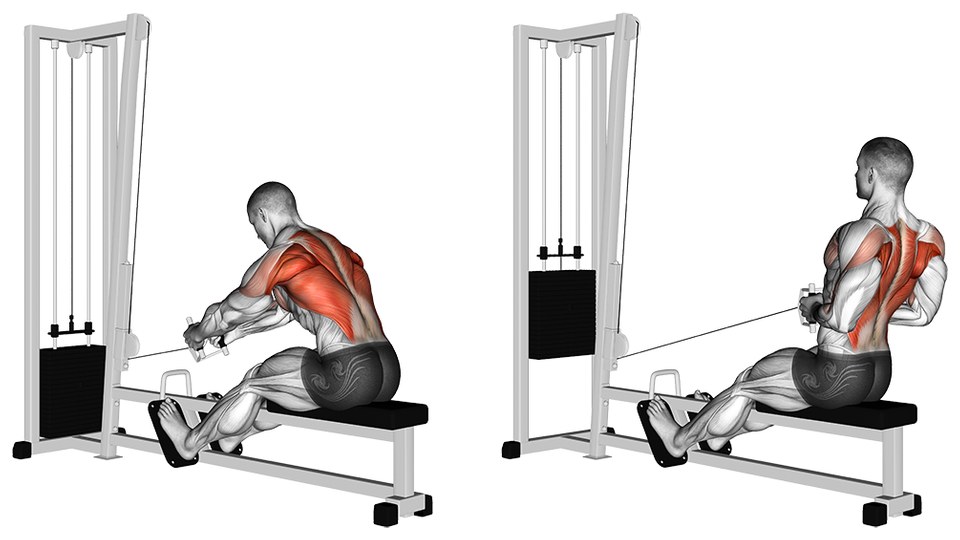
- Seated cable rowAttach a close neutral handle and sit facing the low pulley with your feet on the foot plate and your knees slightly bent.
Frequently asked questions
Should the shoulder blade move in a cable row?
Yes. Let it reach forward as the arm straightens and draw back as you row. Keep the movement controlled and avoid rounding the lower back for extra range.
Where should the handle finish?
Bring it beside the lower ribs with the elbow near your side. Stop before the shoulder rolls forward or the torso has to lean back.
Sources
- Betts JG et al. Anatomy and Physiology 2e, 11.5 Muscles of the pectoral girdle and upper limbs. OpenStax, 2022. https://openstax.org/books/anatomy-and-physiology-2e/pages/11-5-muscles-of-the-pectoral-girdle-and-upper-limbs