
Weighted sit-up
Also called weighted sit ups, weighted situps.
What is a weighted sit-up?
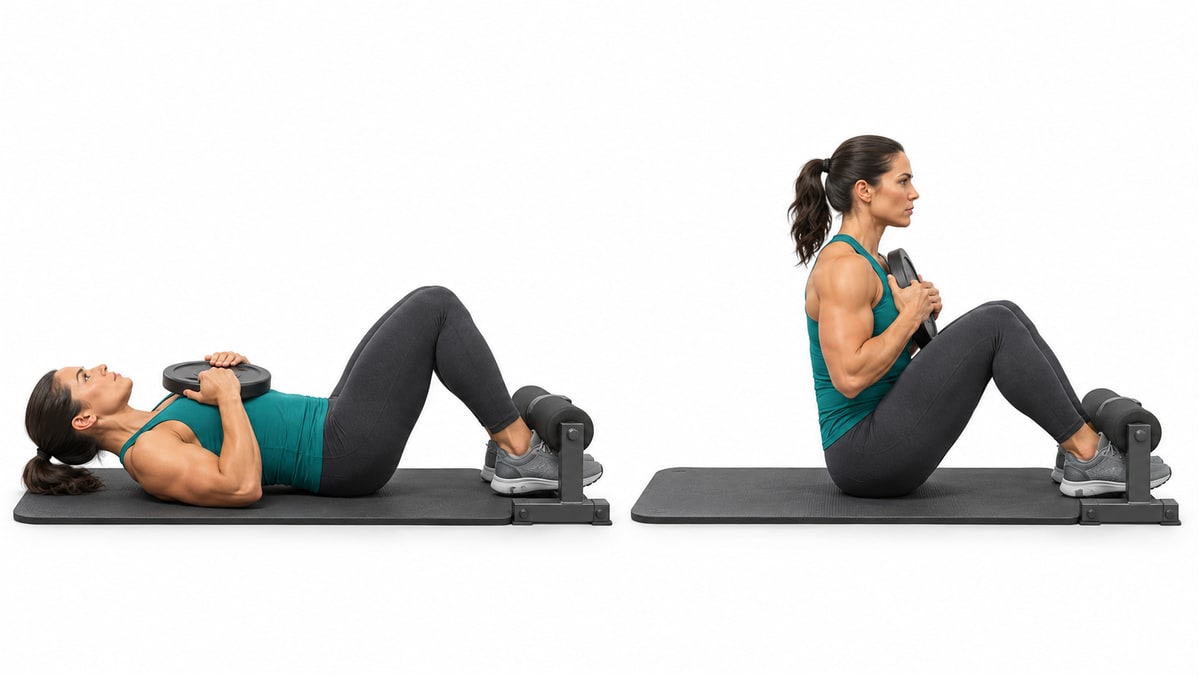
A weighted sit-up is a floor sit-up performed with a weight held against your chest. You rise from lying back to a seated position, then lower to the floor while keeping the weight in place. This guide uses a plate and a fixed foot support.
How do you perform a weighted sit-up?
Set up
- Sit on a mat with bent knees and secure your feet under a fixed, padded foot support. Leave enough space between your knees and chest to sit up without trapping the plate.
- Hold a light plate against your chest with both hands around its edges. Keep a firm grip as you lie back onto the mat.
Execution
- Breathe out and begin curling your upper body up, carrying the plate with your chest.
- Continue into a seated position with your torso approaching your thighs. Keep your feet in place and the plate close rather than reaching it forward.
- Lower your torso steadily until your shoulder blades rest on the mat again.
- Let the movement settle before starting the next rep, keeping both hands on the plate throughout.
Common mistakes
Swinging the plate away from your chest
The set becomes difficult to compare when you change the weight's position to finish each rep. Use a smaller plate if you cannot keep it close.
Dropping onto the mat to rebound
You should be able to stop at the bottom without using the landing to launch the next rep. Reduce the load or end the set when the return gets away from you.
Adding weight before you can finish a bodyweight rep
Practise the same sit-up without the plate first. If a full bodyweight sit-up is still out of reach, use a crunch while you work on a movement you can control.
Where it fits in a session
Use it with your other ab work, usually after the main lifts.
Start without added weight. When you can repeat the full rise and controlled return, try a small plate while keeping the same setup and range.
Muscles worked
Primary
Secondary
Schematic surface view. Some muscles are partly visible or not shown.
Variations
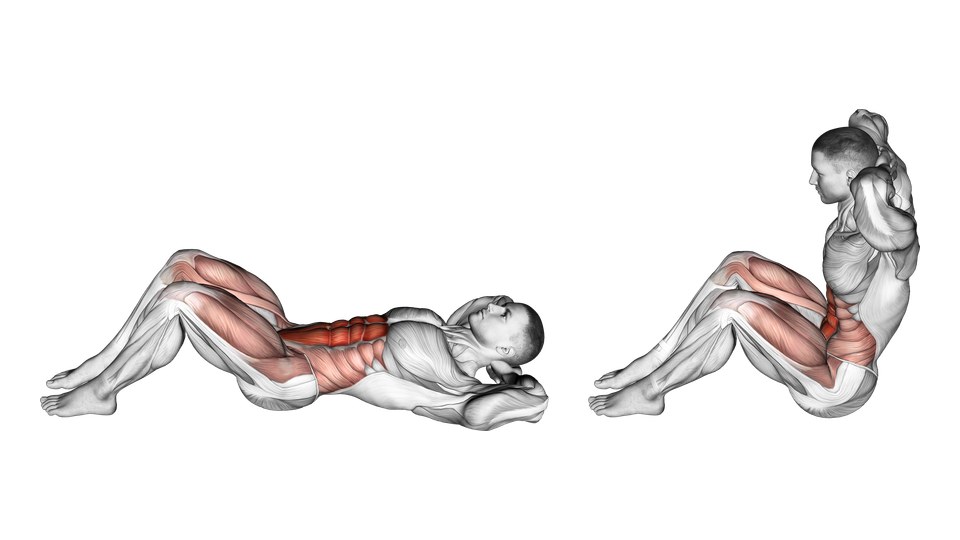
- Sit upsThe bodyweight version is the first regression: put the plate down and practise the full rise and return.
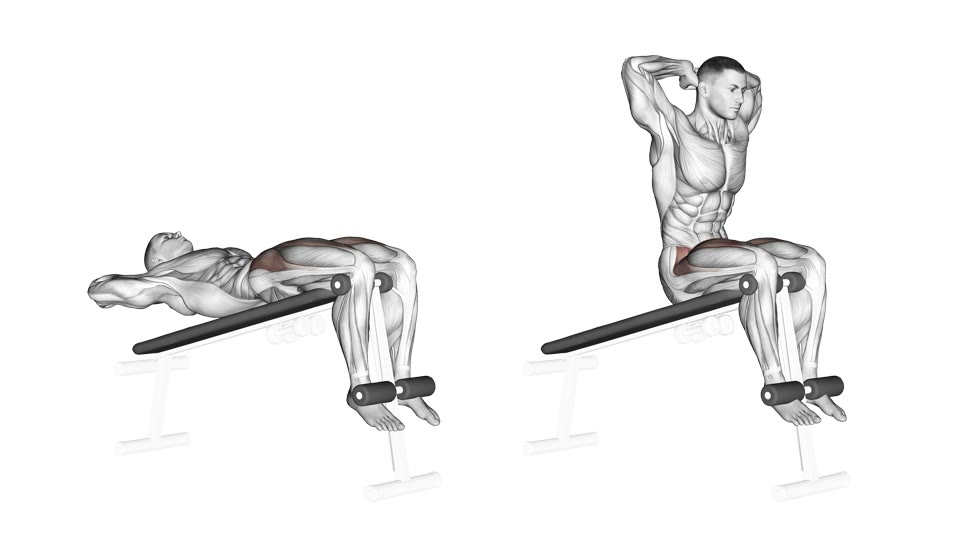
- Decline sit-upPerformed on a decline bench rather than the floor. Keep its training history separate from this floor version.
Frequently asked questions
How much weight should I use?
Choose a plate you can hold securely while sitting up and lowering without swinging it or bouncing off the mat. Start with bodyweight if you are unsure. Add weight in small steps, and put it down if your reps become shorter or rushed.
Do I have to anchor my feet?
This guide uses a fixed foot support. You can perform an unanchored version if your feet stay planted throughout the rep. Treat foot support as a setup choice and keep it consistent when comparing sets. Do not wedge your feet under something that can roll or tip.
Can I use a dumbbell instead of a plate?
Yes, if you can hold it securely against your chest without it slipping or catching your knees. Choose a shape and weight that you can keep still. A weight held overhead or pressed upward is a different setup from the one taught here.
Is a weighted sit-up the same as a weighted crunch?
A weighted sit-up continues into a seated position. A weighted crunch ends after the shoulders lift, with the lower back remaining on the floor. Check the range of motion rather than using the added weight to name the exercise.
Sources
- Juker D, McGill S, Kropf P, Steffen T. Quantitative intramuscular myoelectric activity of lumbar portions of psoas and the abdominal wall during a wide variety of tasks. Med Sci Sports Exerc. 1998;30(2):301–310. doi:10.1097/00005768-199802000-00020. https://pubmed.ncbi.nlm.nih.gov/9502361/