Single-arm cable row
Also called single arm cable row, one-arm cable row, single-arm seated cable row, one arm seated cable row.
What is a single-arm cable row?
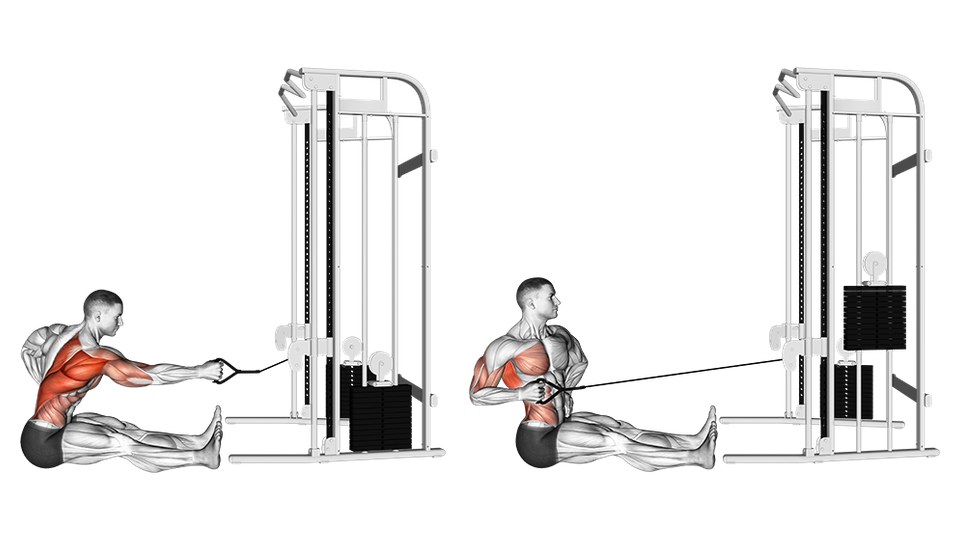
The single-arm cable row is a seated horizontal pull performed one side at a time from a low cable. It trains the lats and upper back while letting the working shoulder blade reach forward and draw back through its own range.
How do you perform a single-arm cable row?
Set up
- Attach one handle to a low cable, sit facing the stack and plant both feet with your knees slightly bent.
- Take the handle in one hand, sit tall and brace. Let the working arm straighten and the shoulder blade reach forward without collapsing your lower back.
Execution
- Pull your elbow back toward your side and bring the handle beside your lower ribs.
- Allow a small controlled turn toward the working side if it follows the shoulder blade, but do not throw the torso backward to start the rep.
- Return slowly, letting the arm straighten and shoulder blade move forward. Complete the set, then repeat on the other side.
Common mistakes
Leaning back to move the handle
Torso momentum replaces the start of the pull. Keep the seated position and allow only the small rotation you can reverse under control.
Pinning the shoulder blade back
That removes its forward-and-back travel. Let it reach as the arm straightens without rounding the lower back.
Twisting farther on every heavy rep
The set gradually becomes a torso rotation rather than a repeatable row. End the pull when the elbow reaches the side and the shoulder blade has drawn back.
Where it fits in a session
Use it as a main unilateral row or after bilateral pulling when each side needs a repeatable cable path.
Start with the weaker side and give both sides the same repetitions and controlled reach. Keep the pulley and seat distance consistent when logging progress.
Muscles worked
Primary
Secondary
Schematic surface view. Some muscles are partly visible or not shown.
The back muscles move the upper arm and shoulder blade on the working side; the elbow flexors assist the pull.
Variations
Frequently asked questions
What muscles does a single-arm cable row work?
It trains the latissimus dorsi, middle and lower trapezius, rhomboids and posterior deltoid on the working side. The elbow flexors assist.
Should you rotate during a single-arm cable row?
A small controlled turn can follow the working shoulder blade, as shown in this guide's asset. Do not use a fast twist or backward lean to launch the handle.
Should the shoulder blade move in a cable row?
Yes. Let it reach forward as the arm straightens and draw back as you row. Keep the movement controlled and avoid rounding the lower back for extra range.
Where should the handle finish?
Bring it beside the lower ribs with the elbow near your side. Stop before the shoulder rolls forward or the torso has to lean back.
Sources
- Anatomy, Back, Latissimus Dorsi. StatPearls. https://www.ncbi.nlm.nih.gov/books/NBK448120/
- Anatomy, Back, Trapezius. StatPearls. https://www.ncbi.nlm.nih.gov/books/NBK518994/
- Anatomy, Shoulder and Upper Limb, Deltoid Muscle. StatPearls. https://www.ncbi.nlm.nih.gov/books/NBK537056/