Single-arm lat pulldown
Also called one-arm lat pulldown, single-arm cable pulldown, unilateral lat pulldown.
What is a single-arm lat pulldown?
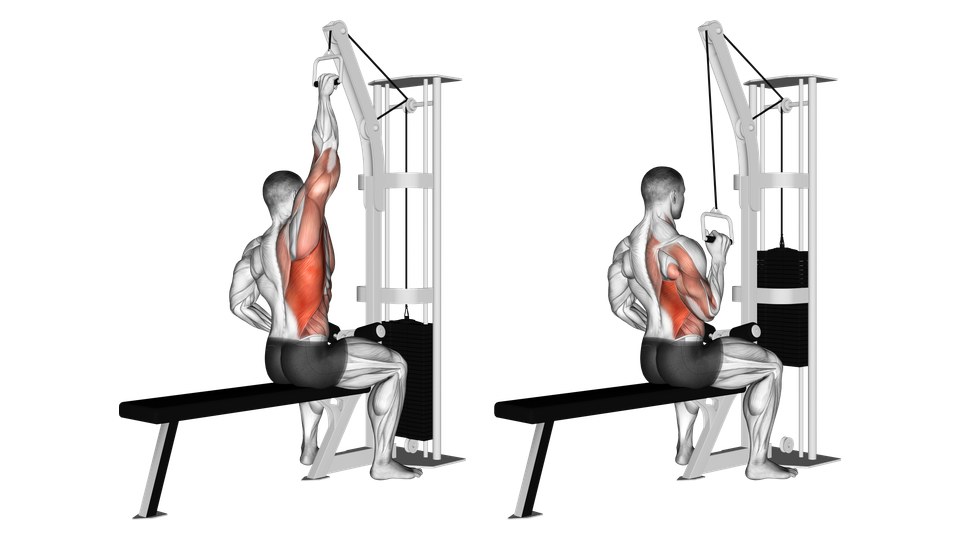
The single-arm lat pulldown is a unilateral cable exercise in which you pull one overhead handle down beside your torso. It trains the latissimus dorsi and teres major, with the biceps and upper-back muscles assisting.
How do you perform a single-arm lat pulldown?
Set up
- Attach one handle to a high pulley and sit or kneel where the cable stays above the working shoulder.
- Hold the handle with the working arm straight overhead, brace your torso and keep both shoulders facing forward.
Execution
- Pull the elbow down beside your ribs while keeping the torso nearly still.
- Stop when the upper arm reaches your side without forcing the shoulder behind the body.
- Return the handle under control until the arm is straight overhead and the shoulder blade rises naturally.
Common mistakes
Twisting away from the cable
Torso rotation helps move the handle and makes the path harder to repeat from side to side.
Curling the handle toward the shoulder
Think about moving the elbow down so the exercise remains a vertical pull rather than mostly an arm curl.
Cutting off the overhead return
Stopping early shortens the trained range and makes progression harder to compare.
Where it fits in a session
Usually used after heavier bilateral pulling or to train each side separately.
Match the torso position and overhead reach on both sides before adding load.
Muscles worked
Primary
Secondary
Schematic surface view. Some muscles are partly visible or not shown.
The latissimus dorsi and teres major pull the upper arm down, while elbow flexors and shoulder-blade muscles assist.
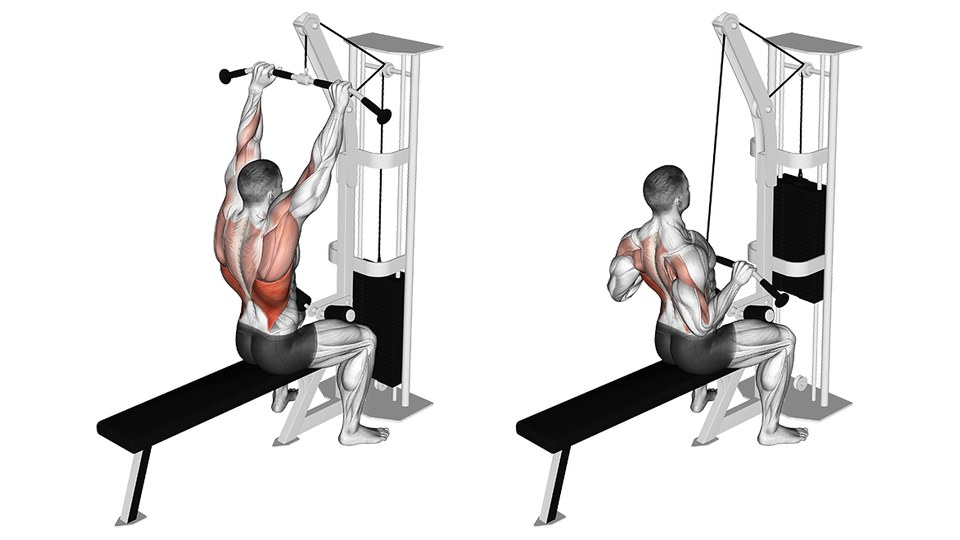
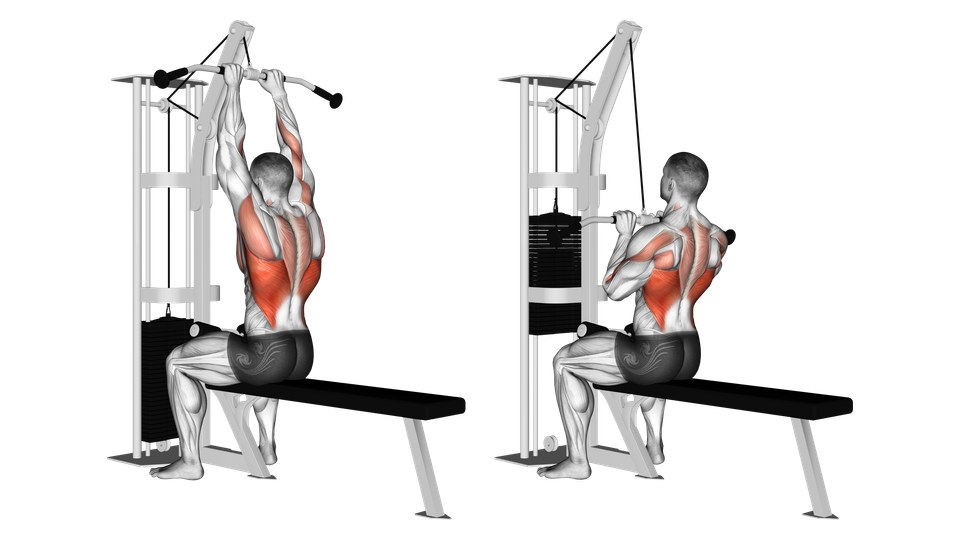
Variations
Frequently asked questions
What muscles do single-arm lat pulldowns work?
They mainly train the latissimus dorsi and teres major. The biceps, rear shoulder and muscles controlling the shoulder blade assist.
Should you lean during a single-arm lat pulldown?
A small fixed lean can be comfortable, but avoid rocking or twisting to move the handle.
Where should the handle finish?
Finish with the elbow beside the ribs and the upper arm near the torso. Pulling far behind the body is unnecessary.
Why use one arm instead of two?
The one-arm setup lets each side move independently and makes side-to-side differences easier to notice.
Sources
- Jeno SH, Varacallo MA. Anatomy, Back, Latissimus Dorsi. StatPearls. https://www.ncbi.nlm.nih.gov/books/NBK448120/
- Syros A, Rizzo MG. Anatomy, Shoulder and Upper Limb, Teres Major Muscle. StatPearls. https://www.ncbi.nlm.nih.gov/books/NBK580487/