Smith machine squat
Also called smith machine squats, Smith squat, Smith back squat.
What is a smith machine squat?
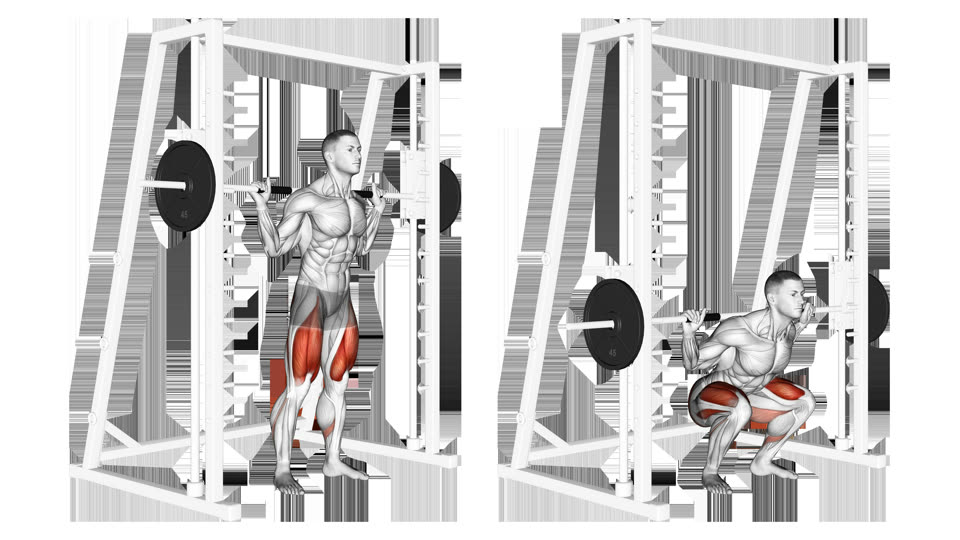
The Smith machine squat is a squat performed with a bar that travels on fixed rails. Set the bar across the upper back, place the feet where you can keep them planted through the guided path, then bend and extend the knees and hips under control.
How do you perform a smith machine squat?
Set up
- Set the bar around upper-chest height and the safety stops just below the lowest position you plan to use.
- Step under, place the bar securely across the upper-back musculature, take an even grip and rotate it free of the hooks.
- Place your feet around shoulder width and adjust them slightly forward or back until the guided bar path lets the whole foot stay planted.
Execution
- Brace, then bend the knees and hips together as you lower along the rails.
- Keep each knee following its toes and descend only as far as you can while the feet stay planted and the bar remains secure.
- Push through the whole foot to straighten the knees and hips, then finish balanced before the next repetition.
Common mistakes
Copying a foot position from another machine
Smith rails can be vertical or angled and body proportions differ. Adjust the stance to the machine in front of you.
Skipping the safety-stop setup
The fixed rails make the stops easy to use. Set them before loading so a failed rep has a defined endpoint.
Forcing depth after the heels lift
Once the whole foot loses contact, the stance no longer fits that range. Change foot position or stop higher.
Where it fits in a session
Use it as the main squat pattern in a machine-focused session or as additional leg work after a free-weight squat.
Log the rail angle, foot position and safety-stop height with the load so later sessions reproduce the same movement.
Muscles worked
Primary
Secondary
Schematic surface view. Some muscles are partly visible or not shown.
The knees and hips extend against the guided bar. Foot placement changes joint angles, so the guide avoids promising a fixed muscle-emphasis split.
Variations
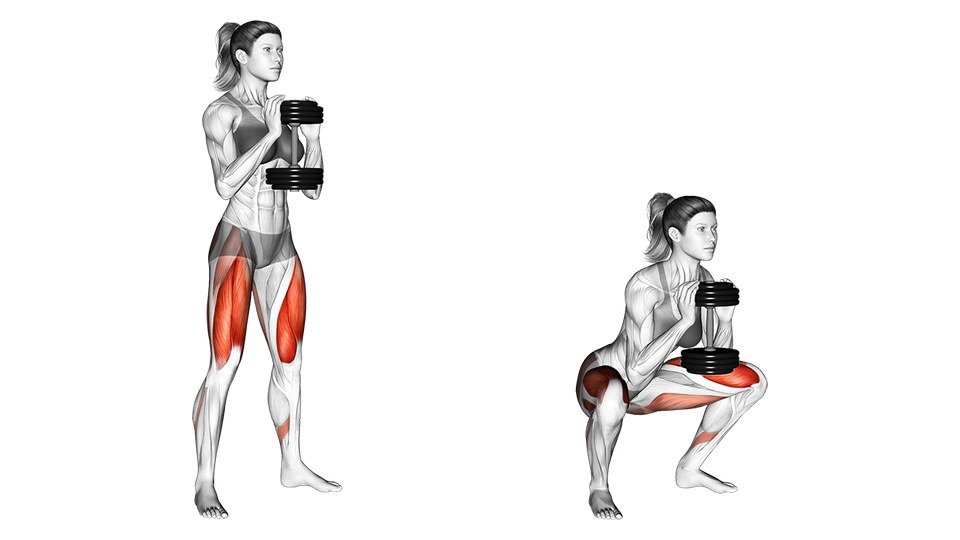
Related tools
Frequently asked questions
What muscles do Smith machine squats work?
They train the quadriceps, gluteus maximus and adductor group as the knees and hips extend. The hamstrings also assist and stabilize.
Where should your feet go for a Smith machine squat?
Start around shoulder width, then move them slightly forward or back until your whole feet remain planted and your knees can follow your toes through the rails' path.
How deep should you Smith machine squat?
Use the deepest range you can control while your feet stay planted, the knees follow the toes and the bar remains secure on the upper back.
Is a Smith machine squat the same as a barbell squat?
No. Both use a bar across the upper back, but the Smith machine guides the bar on rails while a free bar requires you to control its path.
Sources
- Anatomy, Bony Pelvis and Lower Limb: Thigh Quadriceps Muscle. StatPearls. https://www.ncbi.nlm.nih.gov/books/NBK513334/
- Anatomy, Bony Pelvis and Lower Limb, Gluteus Maximus Muscle. StatPearls. https://www.ncbi.nlm.nih.gov/books/NBK538193/
- Anatomy, Bony Pelvis and Lower Limb: Thigh Adductor Magnus Muscle. StatPearls. https://www.ncbi.nlm.nih.gov/books/NBK534842/