
Running
Also called jogging, road running, outdoor running.
What is running?
Running is a repeating gait in which each leg alternates between supporting the body and swinging forward, with a brief phase when neither foot is on the ground. The hips, thighs and calves create and control the stride while the trunk stays organised and the arms counterbalance the legs. A run can serve many different kinds of training, so its session structure belongs to the runner's plan rather than to one universal prescription.
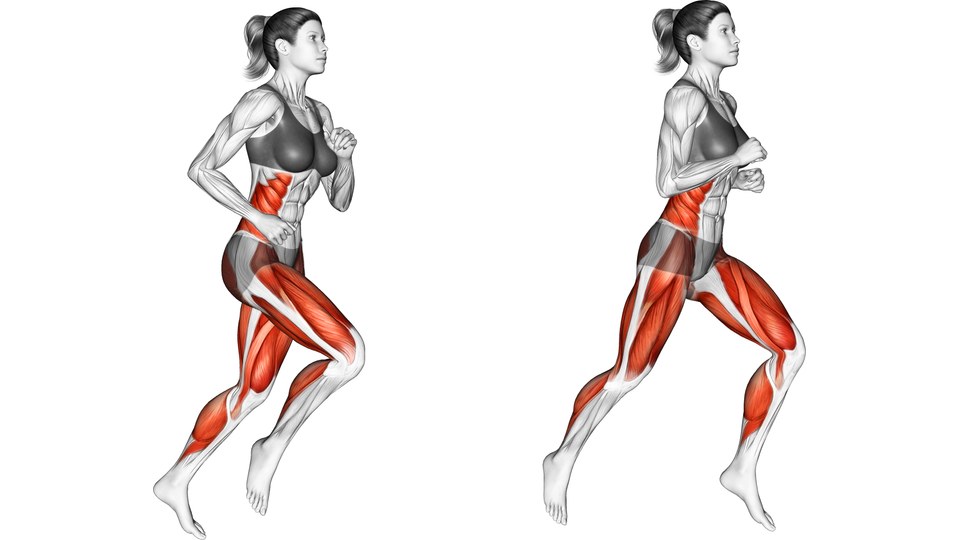
How do you run?
Set up
- Choose a clear route or open surface with enough room to move and stop safely.
- Stand tall, look ahead and let your bent arms rest comfortably by your sides.
Execution
- Move into a run by alternating steps, placing each foot underneath your body instead of reaching far ahead.
- Let your arms swing naturally opposite your legs while your shoulders and hands stay relaxed.
- Keep your trunk upright as you continue, then transition to walking before coming to a stop.
Common mistakes
Reaching each foot far out in front
An exaggerated reach makes every landing harder to control. Let the leg swing through and place the foot closer underneath the body.
Folding forward from the waist
Bending at the waist closes the space for the leg to swing and makes the posture change from step to step. Stay upright through the trunk without forcing the chest up.
Clenching the fists and lifting the shoulders
Extra tension in the hands and shoulders does not help the legs move. Keep the hands loose and let the elbows travel comfortably beside the body.
Forcing one prescribed foot strike
Runners naturally contact the ground in different ways. Do not contort the stride to land on a particular part of the foot; aim for a quiet, controlled contact underneath the body.
Where it fits in a session
Use running wherever your existing training plan places the session.
This guide describes the movement, not a universal workout. The structure of the session depends on why you are running and what the rest of your plan asks from you.
Muscles worked
- quadriceps
- hamstrings
- gluteal muscles
- gastrocnemius
- soleus
- hip flexors
- tibialis anterior
- abdominal muscles
- spinal erectors
Running is a whole-body gait rather than a lift that isolates one muscle. The quadriceps, gluteal muscles and calf muscles support and propel the body during ground contact, while the hamstrings and hip flexors help control and recover the swinging leg. The abdominal muscles and spinal erectors keep the trunk organised as the legs and arms alternate. These groups are listed by role, not ranked by how much work they do.
What lifters actually do
About 12% of regular RepCount users have logged the exact running entry, but it appears in under 1% of workouts. When it is present, runners log about one or two entries inside a session of roughly five exercises. Bench press appears in about 10% of those sessions, pulldowns in 9%, leg extensions and squats in 8%, and dumbbell lateral raises in 8%. The mix describes what was logged alongside running; it does not reveal why the run was included.
Most often trained alongside
Share of running sessions that also include each exercise.
- Bench press10.2%
- Pulldowns8.9%
- Leg extension8.2%
- Squat8.1%
- Dumbbell lateral raise7.7%
Figures come from workouts tracked in RepCount.
Variations
- Treadmill running — Uses a moving belt indoors while the runner stays in one place.
- Trail running — Takes place on unpaved and changing terrain, so footing and route choice become part of the task.
- Track running — Uses a level, measured oval with a predictable surface.
- Hill running — Uses rising or falling terrain, which changes the mechanics and muscular demands of each stride.
Frequently asked questions
What muscles does running work?
Running uses the whole lower body. The quadriceps, gluteal muscles and calves support and propel the body during ground contact; the hamstrings and hip flexors control and recover the leg; and the abdominal muscles and spinal erectors stabilise the trunk. The muscles contribute at different moments, so the list is not a ranking.
What does good running form look like?
A recognisable stride has an upright trunk, relaxed shoulders, arms alternating with the legs and each foot returning underneath the body. There is no single body shape that every runner must copy, so use these as broad landmarks rather than forcing an identical stride.
Should I land on my heel or forefoot?
Do not force one universal foot strike. Runners naturally use heel, midfoot and forefoot contacts, and the same person may change across surfaces or situations. Keep the contact controlled and close to underneath your body instead of reaching for a particular landing.
What should my arms do while I run?
Let the elbows stay comfortably bent and allow each arm to move opposite the forward leg. Keep the hands and shoulders relaxed. The arms mainly counterbalance the motion of the legs rather than propel the body.
Can the same running form be used for different training goals?
Yes. The basic alternating gait does not change because a run is used as a warm-up, cool-down, general cardio or race preparation. What changes is the session plan, which this movement guide deliberately does not prescribe.
How is outdoor running different from treadmill running?
The basic gait is the same, but outdoors you travel over the ground and respond to the route, surface and weather. On a treadmill, a moving belt sets the surface under you and the machine controls belong to the setup.
Is running common in RepCount workouts?
About 12% of regular RepCount users have logged the exact running entry, and it appears in under 1% of workouts. When it appears, it is usually one or two logged entries within a session of about five exercises. Custom running entries are excluded, so those figures describe this shipped label rather than all running recorded by users.
Sources
- Gallo RA, Plakke M, Silvis ML. Common Leg Injuries of Long-Distance Runners: Anatomical and Biomechanical Approach. Sports Health. 2012. https://pmc.ncbi.nlm.nih.gov/articles/PMC3497945/
- Hamner SR, Seth A, Delp SL. Muscle contributions to propulsion and support during running. J Biomech. 2010. https://pmc.ncbi.nlm.nih.gov/articles/PMC2973845/
- Usherwood JR. The functions of leg muscles, structures and mechanisms in running. Biol Lett. 2024. https://pmc.ncbi.nlm.nih.gov/articles/PMC11305130/
- Behm DG, Cappa D, Power GA. Trunk muscle activation during moderate- and high-intensity running. Appl Physiol Nutr Metab. 2009. https://pubmed.ncbi.nlm.nih.gov/20029508/